![Case study: advertising of a computer hardware and components store [3.8 times growth].](https://denysgerman.com/wp-content/uploads/2024/01/127176-telemart-showroom2-1-min.png)

TELEMART.UA is a company that has been dealing with computers since 2013. Since 2019, they have focused entirely on the sale of PCs and everything related to them (gaming accessories, components, etc.). The company has an online store with a wide range of products, as well as about 10 showrooms (offline stores) across the country.
We had an ambitious goal for 2023: to increase sales several times using Google Ads. At the same time, it was necessary to maintain the return on advertising, i.e. ROAS and ROMI. In the end, the results block will contain figures on the number of sales and ROAS. But first, let’s go over the strategy and types of PPC, which will be interesting primarily for marketers and PPC specialists.
Text search advertising
For ecommerce, classic search text advertising is expensive and usually works in the red. I’ve been working with the client’s account for several years, so we’ve already conducted quite a few tests.
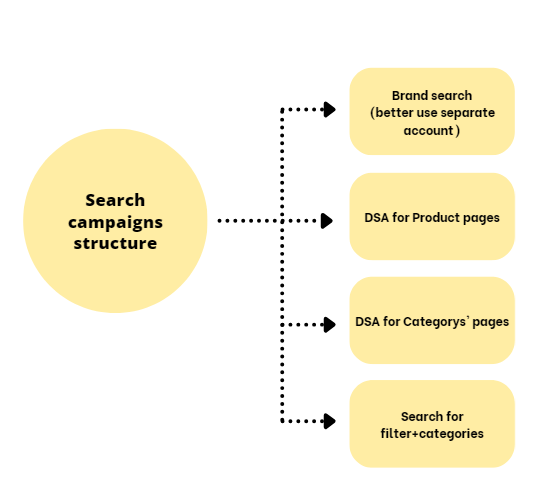
The structure of search campaigns looks something like this:
Now, more about what works well in 2023:
- Branded search advertising. From time to time, competitors start running ads on the client’s brand. To prevent them from stealing branded traffic, we constantly run this type of campaign. Of course, the ROAS and conversion rate will be very high, so you need to keep this in mind and analyze the effectiveness of your account without the numbers for the search brand. And even better – to put such an RC in a separate account.
- Dynamic search to product pages. This type of PPC is very good at collecting low-frequency traffic for keys that will not even be shown in the scheduler. A very large share is accounted for by keys with model names and article numbers. This is relevant traffic of good quality.
- Dynamic search to category pages. This type of PPC is getting worse every quarter, as PMax campaigns are taking over this segment, but it still allows you to collect relevant traffic that converts well. However, this type of PPC works effectively for a small number of categories and only if you have high-quality textual content on your website.
- Classic search by filters + categories. In this case, the filters should not be too broad. For example, “brand+category” will not work. There is a lot of competition, high cost per click, and it is difficult to pay off. You need to test different types of filters in each category and look for something that will work effectively in terms of payback. I would also like to note that this type of PPC pays off only with products that have a good average check. With cheap products, it will simply spiral into the red.
Shopping advertising
Shopping, as with any ecommerce project, generates up to 95% of revenue, so it needs to be given special attention…. In the middle of 2023, I had a very interesting call with a manager from the Google office who was supporting a client’s account. Their general recommendation was to simplify the account structure. Relatively speaking: 1 Performance Max campaign and it will give results. Unfortunately, this does not work with active scaling. And when I showed and explained the structure of our account, the manager was shocked and said that he had never seen anything like it. I won’t reveal all the tricks here, but I will describe the general strategy.
Product advertising works within PMax campaigns and standard shopping. At the same time, PMax generates 75% of sales from the total volume of product advertising. That is, it is more important. The structure of PMax is as follows:
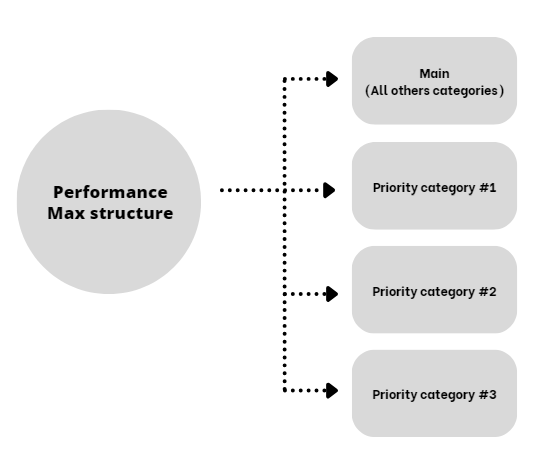
In other words, we have a number of priority categories (there are much more than 3) and each priority category has its own separate PMax campaign with a separate budget and strategy. And all non-priority categories are advertised as part of the Main campaign. To make it easy to manage such a structure, it is necessary to pass the product_type parameter in the feed, which corresponds to the product categories and subcategories on the site.
Each PMax for priority categories has a different structure inside. Sometimes it’s just 1 set without signals and objects, sometimes it’s many sets by brand or subcategory. What works best is selected through experimentation and there is no single structure that would be suitable for all categories.
25-30% of sales are generated by classic standard shopping. To make it work in parallel with PMax, you have to work on the feeds in the Merchant Center. I know that many specialists don’t like this, but at the time of writing this case study, it still works for me and on more than one project.
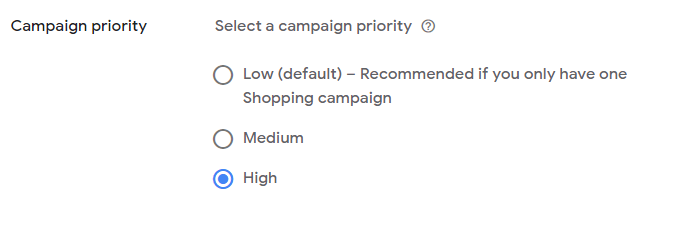
The structure of standard product campaigns is similar to PMax, but some technical settings differ. For example, we can immediately add minus word lists without contacting support and we can not exclude priority categories from the “Main” campaign, but simply set the correct priorities through the campaign level settings:
Demand Gen & Display
We don’t use these types of campaigns as part of a performance strategy, where our goal is to get the most orders placed through the shopping cart with the highest possible return on investment. However, they are quite good at promotional activities and at driving leads to other (related) services of the client’s company.
Results
Note that the figures you will see below take into account only the performance of the campaign (not to be confused with PMax). Performance campaigns are those that have the main goal of getting an order through the shopping cart with the maximum payback. And I specifically excluded campaigns with other strategies, such as branded search, various promotions, and local PPC, from the statistics so as not to deceive you and myself.
Of course, I don’t disclose data on advertising budget, revenue, average check, and price per transaction, as this is confidential information about a particular project. I show this kind of data only in cases where the client’s brand remains incognito.
Dynamics by months from October 2022 to December 2023:
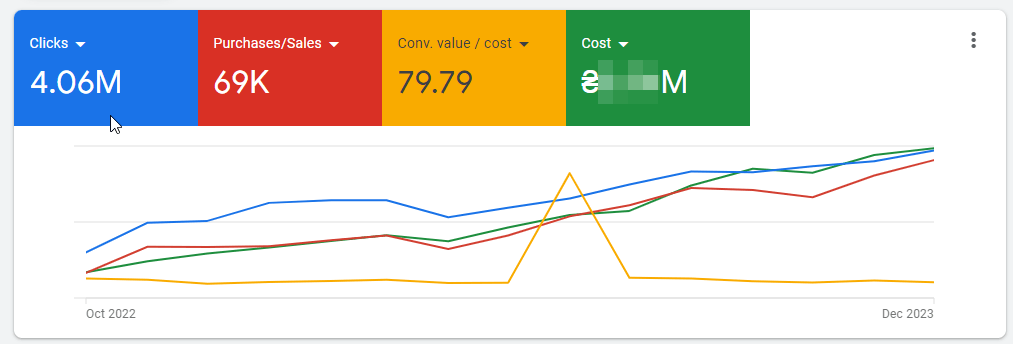
Unfortunately, in June, we had 3-5 spam orders for many millions of hryvnias (most likely from competitors), so the ROAS graph (yellow line) has such a spike. Probably, competitors wanted to break our smart strategies, but I took the necessary corrective measures in time and the account’s efficiency was not affected by this spam attack.
In this niche, the high season is the 4th quarter. Therefore, we will separately compare the 4th quarter of 2022 with 2023 to understand the scale of growth:
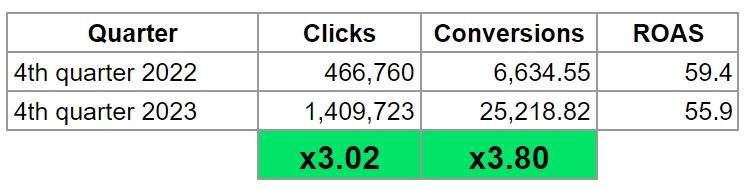
That is, we have increased the number of sales through the shopping cart by almost 4 times. At the same time, the average ROAS dropped by only 3.5 points, which is much less than we expected.
Feedback from the CMO of TELEMART.UA: